
Ancient Rome’s political landscape is defined by two significant periods: the Roman Republic and the Roman Empire. The Republic, established in 509 B.C.E., introduced a system where elected officials and assemblies shared governance, while the Empire centralized power under the emperor’s authority.
Throughout this political transition, Roman lawmakers played a vital role. Their responsibilities, powers, and influence evolved dramatically, reflecting shifts in governance, social structure, and military dominance. For example, during the Republic, agriculture was a crucial driver of Rome’s economic growth, influencing social development as well.
This article titled From Republic to Empire: The Changing Role of Roman Lawmakers examines how Roman lawmakers adapted and transformed from the collaborative legislative bodies of the Republic to the centralized autocracy of the Empire. You will explore the dynamics behind this political transition, the changing roles of key institutions such as those that governed women’s rights – the legal status of Roman women, and the lasting impact on Roman legal traditions.
The Political Structure of the Roman Republic
The Roman Republic governance began in 509 B.C.E. following the overthrow of the last Etruscan king. This system introduced a complex balance of power designed to prevent any single individual from dominating the state. Central to this structure was the Senate, an advisory body composed mainly of patricians—Rome’s aristocratic elite. The Senate held significant influence, shaping policy and foreign affairs, but lacked formal legislative authority.
Legislative Assemblies and Shared Governance
Legislation was created and approved through various legislative assemblies, which represented different segments of Roman society. These assemblies allowed citizens to vote on laws and elect magistrates, providing a framework for shared governance.
The Role of Consuls
Two consuls were elected annually by these assemblies, serving as the highest magistrates. Their duties included presiding over the Senate, commanding the military—an aspect that highlights the role of the Roman Army in shaping an empire—and administering government affairs. The consuls embodied executive power but were limited by their one-year term and mutual veto rights.
Social Divisions and Political Dynamics
A key feature of this republican system was the sharp division between patricians and plebeians. Patricians monopolized political offices in the early Republic, while plebeians—commoners—had limited access. This social distinction influenced political dynamics and fueled demands for broader participation, setting the stage for future reforms in Roman lawmaking institutions. Daily life in Ancient Rome was vastly different for these various social classes, especially between the patricians and plebeians, which further complicated their political relationships.
Entertainment and Social Relationships
Despite its political complexities, the entertainment aspects of Ancient Rome such as gladiators, chariot races and theaters played a significant role in shaping social relationships and influencing political authority.
Architectural Power
Meanwhile, the architectural prowess demonstrated through Roman architecture served not only functional purposes but also stood as a testament to their power and cultural identity.
Expansion of Political Participation: Plebeians and Legislative Bodies
The Roman Republic’s early political system heavily favored the patrician class, leaving plebeians with limited influence. This imbalance sparked a prolonged struggle as plebeians sought recognition and rights within the political framework. Their efforts led to significant political reforms that reshaped the Republic’s representative democracy.
1. Struggle for political power
Plebains, who were the common people of ancient Rome, challenged patrician dominance through protests and secessions, demanding access to public office and legal protections.
2. Creation of the Concilium Plebis
Around 494 B.C.E., the plebeians established their own assembly, the Concilium Plebis (Council of the Plebs). This body allowed plebeians to pass resolutions known as plebiscita, which initially applied only to plebeians but later gained the force of law for all Romans.
3. Significance in legislative processes
The Council of the Plebs elected tribunes who held sacrosanct status, protecting plebeian interests by vetoing unjust acts and influencing legislation. This mechanism introduced a new layer of checks on patrician authority.
4. Evolution towards representation
These developments marked a gradual shift from an exclusive aristocratic system, dominated by patrician masters of Roman luxury and power, to a more inclusive form of governance. Political offices slowly opened to plebeians, and laws increasingly reflected broader citizen participation.
This expansion of political participation enhanced the Republic’s complexity, balancing elite power with popular representation while laying groundwork for future conflicts and reforms.

Challenges to Republican Governance: Internal Conflicts and Civil Wars
The Roman Republic faced escalating social conflicts stemming from deepening divisions between the elite patricians and the broader population, including wealthy equestrians and ambitious plebeians. Competition for political influence intensified as powerful individuals sought to leverage social unrest for personal gain.
Civil wars in the 1st century B.C.E. erupted from these tensions and rivalries. Key causes included disputes over land reforms, debt relief, and military command, which polarized Roman society. The breakdown of traditional republican norms weakened institutions meant to balance power.
The Rise of Julius Caesar
Julius Caesar emerged as a pivotal figure during this turmoil. His military successes in Gaul expanded Rome’s territories and bolstered his popularity. Caesar’s strategic brilliance and political savvy positioned him as a dominant force capable of reshaping Roman governance.
The Crossroads of Power
The moment Caesar crossed the Rubicon River in 49 B.C.E. symbolized a decisive challenge to the Republic’s authority—igniting civil war against Pompey and the Senate. This act broke the constitutional barrier separating military command from political power.
Shifting Dynamics
Caesar’s subsequent dictatorship concentrated authority in a single individual, undermining the Republic’s legislative processes. His reforms attempted to stabilize governance but also highlighted the erosion of collective lawmaking.
This shift toward autocratic rule marked a critical phase in the transformation From Republic to Empire: The Changing Role of Roman Lawmakers.
Lasting Legacies
This transformation had long-lasting effects on legal systems, evident in the enduring influence of the Corpus Juris Civilis, a comprehensive codification of Roman law commissioned by Emperor Justinian I in the 6th century AD. This body of civil law not only preserved ancient Roman legal principles but also adapted them to meet contemporary societal needs, marking a significant turning point in the development of legal systems, particularly in Europe.
Transition from Republic to Empire: Centralization of Power under Augustus
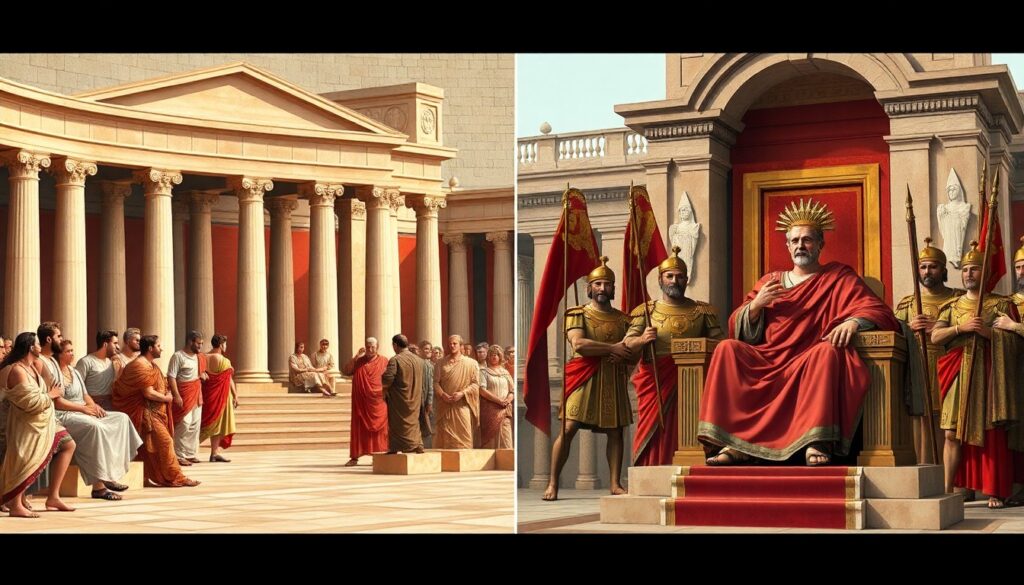
The assassination of Julius Caesar in 44 B.C.E. plunged Rome into chaos. Competing factions vied for control, sparking a series of civil wars. Amid this turmoil, Octavian—later known as Augustus—emerged as the definitive leader. His political acumen and military successes enabled him to outmaneuver rivals like Mark Antony and solidify his position.
Augustus’ reign marks the establishment of the Roman Empire and a fundamental shift in governance. The republican model of shared legislative authority gave way to centralized imperial control. Augustus maintained the facade of republican institutions, but real power resided firmly with him. This shift redefined the role of lawmakers and their influence.
Key elements of Augustus’ consolidation of power included:
- Law introduction and veto rights: Augustus assumed authority to propose, enact, and block legislation without needing approval from traditional assemblies.
- Military command: He held supreme command over the legions, ensuring loyalty directly to the emperor rather than to the Senate or consuls.
- Appointment control: Augustus controlled key political and administrative appointments, effectively shaping Rome’s governing class.
Through these powers, Augustus transformed imperial authority into a centralized system where lawmaking and executive decisions answered primarily to the emperor. This new structure laid the foundation for centuries of Roman imperial governance.
The Changing Role of Legislative Bodies under the Empire
The Senate’s Transformation
The Senate under Empire still existed formally but lost much of its power to make laws. During the Republic, the Senate was a strong advisory and discussion group, but under imperial rule, it became mostly ceremonial. Instead of shaping policies or laws on its own, the Senate’s role shifted to legitimizing the emperor’s decisions. Senators often endorsed imperial orders, creating an illusion of continuity with the Republic while real authority lay elsewhere.
Decline of Popular Assemblies
Popular assemblies, which were once crucial for citizen involvement in making laws, saw a significant decrease in power. These bodies, like the Comitia Centuriata and Comitia Tributa, used to have the authority to pass laws, elect magistrates, and make important choices. However, under the Empire, their functions either got taken over by the emperor or became unnecessary. This decline in influence of popular assemblies meant that regular Roman citizens had less direct say in the legislative process. Lawmaking shifted from being a collective decision-making process to more imperial decrees.
Emperor’s Control over Legislation
The emperor held dominance over legislation and administrative decisions, having control over introducing, changing, and canceling laws. Imperial laws were often issued through edicta, rescripta, and mandata—official orders that had the force of law without needing senatorial approval. The emperor’s authority over governance was further strengthened by military command, appointment powers, and judicial authority. While legislative bodies still existed alongside imperial power, they no longer had real influence over Rome’s political direction.
Interestingly, this shift in power dynamics has parallels in modern role-playing scenarios such as those found in Second Life, where players can immerse themselves in historical contexts like that of ancient Rome, exploring different facets of life during that era.
Governance Reforms and Administrative Challenges in the Imperial Era
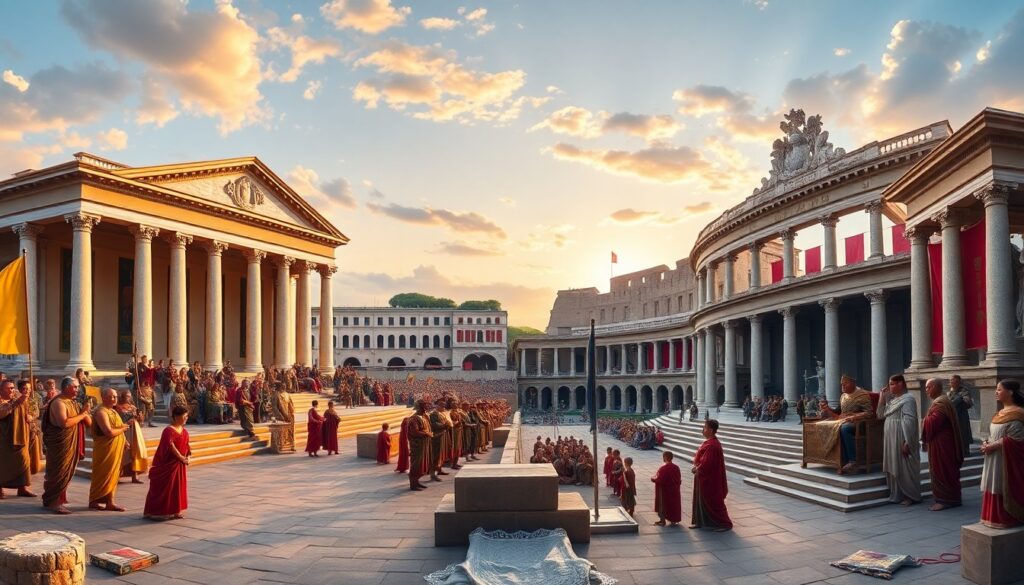
The vast size of the Roman Empire, as explored in detail in resources like this journey through ancient Rome, presented significant challenges for Roman Empire administration. Territories stretched across Europe, North Africa, and parts of Asia, making centralized governance increasingly complex. Communication delays, local resistance, and logistical difficulties strained the traditional structures inherited from the Republic.
Diocletian’s reforms marked a critical response to these challenges. Around the late 3rd century C.E., Emperor Diocletian implemented a major administrative overhaul by dividing the empire into eastern and western halves. This division aimed to improve efficiency by delegating authority to co-emperors and subordinate officials, creating a tetrarchy — rule by four.
Key features of these reforms included:
- Decentralization of power to regional administrators, reducing the overwhelming burden on a single ruler.
- Creation of smaller provinces grouped into larger dioceses for better local management.
- Enhanced control over taxation and military recruitment to stabilize the empire’s economy and defense.
These changes directly affected lawmaking structures. The emperor’s role became even more pronounced as regional governors executed imperial edicts rather than initiating laws themselves. The Senate’s influence waned further, confined mostly to ceremonial duties within the imperial framework.
Governance stability improved temporarily, but the division also set precedents for political fragmentation. It reflected a transformation from the Republic’s legislative collaboration to an empire increasingly reliant on imperial authority and bureaucratic administration.
Decline of Imperial Authority and Legacy of Roman Lawmakers
The decline of imperial authority was caused by several factors working together:
- Internal conflicts weakened political unity as rival groups and generals fought for power.
- Economic burdens increased due to heavy taxes, inflation, and disruptions in trade routes.
- Outside invasions by Germanic tribes, Huns, and other groups put a strain on Rome’s military and resources.
These factors led to the fall of the Western Roman Empire in 476 C.E., which marked the end of centralized Roman political power in the west. The last emperor, Romulus Augustulus, was overthrown by the Germanic leader Odoacer, symbolizing the collapse of Roman governance systems in Western Europe.
The Eastern Roman Empire, also known as the Byzantine Empire, continued to exist until 1453 C.E., preserving many Roman legal and administrative traditions. Despite losing territory and facing changing political realities, this continuation ensured that a distinct legacy of Roman law and governance remained.
Roman legal principles had a significant impact on medieval European law codes and modern legal systems. Ideas such as written laws, individual rights, and government procedures can be traced back to the work of Roman lawmakers. Even though the roles of lawmakers changed drastically—from republican assemblies to imperial autocrats—the fundamental structure they established survived beyond the empire’s political existence.
The legacy of Roman law is still a fundamental part of Western legal tradition, showing how changes in lawmaking institutions did not erase Rome’s deep influence on governance and justice.
Conclusion
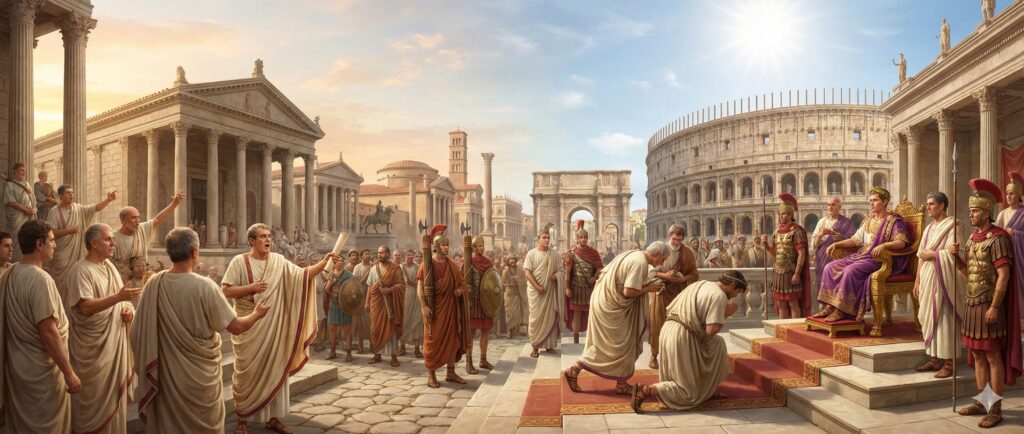
The evolution of Roman lawmakers from the Republic to the Empire represents a profound transformation in political authority and governance. Initially characterized by shared power among elected officials, assemblies, and the Senate, this system gradually gave way to centralized control under the emperor. This shift redefined the role of lawmakers, reducing citizen participation and senatorial influence while concentrating legislative and administrative powers in imperial hands.
Key reflections on this transition highlight:
- The creation of legal traditions that balanced republican ideals with imperial pragmatism. This transformation is part of the larger narrative of Roman Law, which has played a crucial role in shaping modern legal systems.
- The enduring influence of Roman law on subsequent legal systems across Europe and beyond.
- How political authority evolved to meet the challenges of managing an expansive and diverse empire. The Roman Roads, for instance, played a significant role in maintaining and expanding the empire.
From Republic to Empire: The Changing Role of Roman Lawmakers is not just a historical narrative but a case study in adapting governance structures to shifting social, political, and territorial realities. The legacy of this transformation continues to resonate in modern concepts of law, authority, and statecraft.
Additionally, it’s important to note how Stoicism, a philosophical school that emphasized living in harmony with nature and practicing virtue, became popular in Roman culture during this period. This philosophical shift influenced the thoughts and actions of important thinkers throughout the empire.
Moreover, the era also saw remarkable advancements in infrastructure and engineering, as evidenced by 10 incredible Roman engineering feats that changed the world. These engineering marvels not only served practical purposes but also connected far-flung regions, ensuring effective governance and cultural exchange.
Finally, we cannot overlook the social aspects of Roman life during this transitional period. The popularity of gladiatorial games raises intriguing questions about societal values at the time. Were these gladiators viewed as heroes or victims within Roman entertainment? Such inquiries delve deeper into understanding the complexities of Roman society beyond its political transformations.
FAQs (Frequently Asked Questions)
What was the political structure of the Roman Republic?
The Roman Republic, established in 509 B.C.E., featured a governance system with power shared among the Senate, consuls, and legislative assemblies. The Senate acted as an advisory body composed mainly of patricians, while legislative assemblies represented both patricians and plebeians. Consuls were elected officials responsible for executive duties, reflecting a complex balance of power influenced by social class distinctions.
How did plebeians expand their political participation during the Roman Republic?
Plebeians struggled for political rights leading to significant reforms such as the creation of the Concilium Plebis (Council of the Plebs). This body allowed plebeians to have direct representation and influence in legislative processes, marking an evolution towards a more representative system within the Republic and increasing inclusion in government decisions.
What challenges led to the decline of Republican governance in Rome?
Internal conflicts and civil wars characterized by social tensions between classes and elite individuals undermined Republican stability. Key events included Julius Caesar’s rise to power, his military achievements, crossing the Rubicon as a pivotal moment, and his subsequent dictatorship, which concentrated power and weakened traditional republican lawmaking structures.
How did Augustus centralize power during the transition from Republic to Empire?
Following Caesar’s assassination and ensuing struggles, Augustus consolidated authority as Rome’s first emperor. He shifted lawmaking powers from shared legislative bodies to centralized imperial control, gaining new powers such as introducing laws, veto rights, military command, and controlling appointments, effectively transforming Rome’s governance into an imperial system.
What changes occurred in legislative bodies under the Roman Empire?
Under the Empire, the Senate continued to exist but with diminished power largely symbolic and legitimizing imperial authority. Popular assemblies declined significantly, reducing citizen participation in lawmaking. The emperor dominated legislation and administrative decisions, marking a shift from republican shared governance to autocratic rule.
What was the legacy of Roman lawmakers after the fall of the Western Roman Empire?
Despite pressures like internal strife and external invasions leading to the Western Roman Empire’s fall in 476 C.E., Roman legal principles endured through the Eastern (Byzantine) Empire until 1453 C.E. The evolving role of lawmakers throughout Rome’s history left a lasting impact on legal traditions and governance structures that influenced subsequent civilizations.