
Roman governors played a crucial role during the Late Republic and early Principate, acting as the Empire’s primary agents of control in distant provinces. Their responsibilities included military command, tax collection, and judicial authority, making them powerful figures whose actions greatly impacted provincial life.
This article explores key themes surrounding Roman Governors: Corruption, Reform, and Provincial Power Plays. The story reveals how unchecked power often led to corruption, while efforts at reform aimed to stop abuses and bring back order. Power struggles within provinces often mirrored larger political conflicts between Rome’s central authorities and local ambitions.
Understanding how provincial governance worked is important for understanding the overall stability of the Roman Empire. The challenges faced by governors—such as self-interest and systemic inefficiencies—teach us important lessons about managing diverse territories in a large imperial system.
To further comprehend the complexities of Roman governance, it is beneficial to delve into resources such as Men of Pompeii, which offers extensive insights into the fascinating world of Ancient Rome. This includes an exploration of the structure of power during the Roman Republic, a period that marked a significant transition in governance from monarchy to a complex political structure.
Moreover, understanding the economic aspects such as the role of agriculture in Roman economic growth can provide a more rounded perspective on how these governors operated within their provinces.
Lastly, exploring daily life in ancient Rome and understanding the social class divide, particularly between patricians and plebeians can shed light on the societal context within which these governors functioned. The patricians, being the wealthy and powerful elite, often had significant influence over provincial matters.
The Role and Powers of Roman Governors
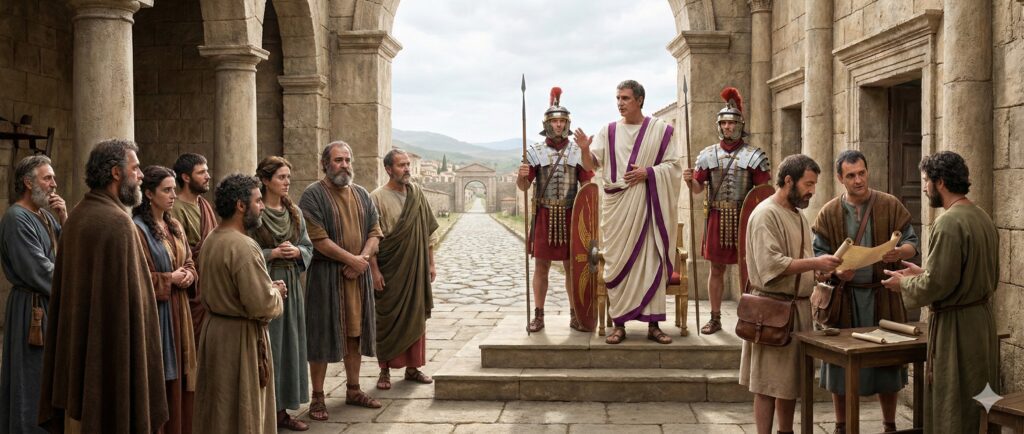
The governance structure of ancient Rome, a civilization known for its vast empire and rich history, is an intriguing subject. The Roman provincial authority rested heavily on the shoulders of governors, who exercised a broad range of powers within their assigned territories. Their responsibilities included:
1. Military Command
Governors acted as commanders of legions stationed in their provinces, controlling local security and defense against external threats or internal unrest. This role was crucial considering the Roman Army’s military might which played a vital role in the growth and upkeep of the empire.
2. Tax Collection
They oversaw the gathering of revenues, often through complex systems involving publicani or local administrators, ensuring Rome’s financial interests were met.
3. Judicial Authority
Governors held supreme legal power within their provinces. They presided over civil and criminal cases, with the ability to issue judgments impacting both Roman citizens and provincials. This aspect of governance was deeply influenced by Roman Law, which has played a crucial role in shaping modern legal systems.
Governors wielded near-absolute autonomy once installed in their provinces. Distance from Rome and limited communication meant they operated with minimal immediate oversight. This autonomy extended to decisions on military deployments, tax assessments, and legal rulings without direct interference.
The Roman Senate’s weak supervisory mechanisms allowed governors considerable latitude. Senate decrees were often vague or delayed, reducing effective control. This lack of stringent monitoring created an environment where governors could prioritize personal gain or political ambition over imperial stability.
Such expansive powers combined with insufficient checks shaped provincial governance dynamics and set the stage for challenges related to corruption and power struggles in later periods. The philosophical underpinnings of some governors’ actions might have been influenced by Stoicism, a school of thought that emphasized living in harmony with nature and using reason as paths to achieving human flourishing.
To maintain control over such vast territories, the Romans developed an extensive network of roads which facilitated movement and communication across the empire.
Corruption and Inefficiency in the Late Republic
The tax farming system was central to provincial revenue collection during the Late Republic. Publicani—private contractors—secured tax collection rights through competitive bidding, known as auction-based tax farming. This method intended to maximize state income by awarding contracts to the highest bidders.
However, auction-based tax farming created incentives for collusion between governors and publicani. Governors often favored certain contractors, ensuring contracts were awarded to allies willing to share profits illicitly. This alliance facilitated widespread corruption, as both parties exploited the system for personal gain rather than provincial welfare.
Consequences of this corruption were severe:
- Provincial populations faced excessive taxation, forced levies, and brutal enforcement tactics.
- Roman state revenues suffered from underreporting or mismanagement once funds passed through corrupt hands.
- Public trust eroded as abuses went unchecked, fueling unrest and resistance.
Examples of abuses highlight governors’ self-interest and lack of accountability:
Governors inflated tax demands to enrich themselves and their associates.
Some imposed arbitrary fines or confiscated property under dubious charges.
Provincial courts often served governors’ interests rather than justice.
Weak Senate oversight allowed these practices to flourish. The absence of effective monitoring mechanisms meant governors operated with near impunity, perpetuating inefficiency and exploitation across the provinces.
This period also saw a significant intertwining of politics with other aspects of Roman life, such as religion. The religious practices of the Romans influenced politics, culture, and social structures significantly.
Moreover, the legal status of women in Rome during this period was marked by a complex interplay of rights and restrictions. This intricate legal framework surrounding Roman women significantly influenced gender dynamics in ancient Rome.
In contrast to these systemic issues, certain individuals like gladiators emerged within Roman society. They were brave warriors admired for their skills in battle but also victims of a complex social system. This duality raises questions about their status in society which is explored in detail in discussions about gladiators.

The Challenges of Provincial Governance and Power Plays
The autonomy granted to Roman governors often translated into significant independence from Senate oversight. Many governors leveraged this freedom to raise private armies, a move that defied Senate mandates and allowed them to exert military and political influence beyond their official duties. These private forces were not only tools of enforcement but also symbols of personal power, enabling governors to act as de facto rulers within their provinces.
Appointment Practices and Systemic Weaknesses
Appointment practices contributed heavily to systemic weaknesses. Many governors arrived inadequately prepared, lacking the administrative skills or local knowledge necessary for effective governance. This gap in competence intensified the risk of corruption and mismanagement, fueling ongoing instability.
Power Struggles in Provincial Governance
Provincial governance became a battleground for power struggles. Governors frequently pursued personal ambitions and political agendas, often at odds with imperial interests or local welfare. These contests sometimes escalated into violent confrontations between rival factions supported by different governors or local elites, complicating Roman efforts to maintain control.
Consequences of Provincial Power Plays
The consequences of these provincial power plays were severe:
- Erosion of provincial stability through lawlessness or factional conflict.
- Undermining imperial authority, as governors prioritized self-interest over Rome’s broader goals.
- Increased difficulty in implementing consistent policies across diverse regions.
Such challenges reveal the fragile balance between provincial autonomy and central control, highlighting why reforms targeting governor accountability became crucial in the empire’s evolution.
The Broader Context of Power Dynamics
However, it’s essential to recognize that these power dynamics were not isolated phenomena. They were deeply intertwined with the broader socio-political landscape of Rome, which included a rich tapestry of cultural influences, architectural innovations, and social structures.
- For instance, the spectacle of ancient Rome, characterized by gladiatorial games and chariot races, played a significant role in shaping societal relationships and political authority during this era.
- Moreover, the masterpieces of Roman architecture stand as a testament to the innovative spirit of the Romans. These structures were not merely functional; they served as symbols of power and cultural identity.
- On the other hand, understanding the lives of plebeians is crucial for grasping the social dynamics of Rome. As the majority who were not part of the patrician elite, plebeians significantly influenced the development of political and economic structures.
- Lastly, it’s worth noting that Roman mythology has left a lasting impact on modern culture. The Romans adapted Greek myths to reflect their societal norms and political aspirations, which continues to resonate today.

Augustus’ Reforms and the Transition to the Principate
The shift from Republic to Principate marked a significant change in how the Roman Empire governed its provinces. Augustus implemented reforms that completely overhauled the administration, with the goal of reducing the chaotic independence that governors had enjoyed during the Republic.
Key changes included:
- Centralization of authority: Augustus established a bureaucratic hierarchy that ensured tighter imperial control over provincial affairs. This new system replaced the loosely supervised, often self-serving governance of previous eras with appointed officials accountable directly to the Emperor.
- Provincial classification: Provinces were divided into two main categories reflecting their strategic importance:
- Senatorial provinces remained under Senate oversight, typically peaceful and less militarized.
- Imperial provinces fell under the Emperor’s direct command, often frontier regions requiring military presence and stronger administrative oversight.
- Introduction of censuses and registries: Accurate population counts and property assessments became essential tools for improving tax fairness and resource management. These measures enhanced transparency, reducing opportunities for tax evasion and corruption.
These reforms created a more organized framework known as the Principate administration. This restructuring reduced governors’ unchecked powers by embedding them within a system designed for accountability and efficiency. The emphasis on strategic provincial management reflected Rome’s evolving priorities as it transitioned from an expansionist republic into a stable empire.
The transition from monarchy to republic, which laid the groundwork for these reforms, is a significant part of the birth of the Roman Republic. This historic shift not only altered Rome’s political landscape but also influenced modern governance structures.
Moreover, Augustus’ reforms had lasting impacts on legal systems, evident in the enduring influence of the Corpus Juris Civilis commissioned by Emperor Justinian I centuries later.
Furthermore, these reforms were complemented by remarkable Roman engineering feats that facilitated effective governance and cultural exchange across vast territories.
Improvements in Tax Collection and Oversight Under Augustus’ Reforms
Augustus’ tax reform marked a decisive break from the corrupt and inefficient practices of the Late Republic. The reliance on publicani, private tax contractors, was largely replaced by local administrations supervised by imperial agents. These imperial officials acted as direct representatives of the emperor, tasked with overseeing tax collection and curbing abuses that had previously flourished under auction-based tax farming.
Key features of this reform included:
- Imperial agents were embedded within provincial governments to monitor finances closely, reducing opportunities for governors and tax collectors to engage in collusion or fraud.
- The introduction of censuses and registries provided a more accurate assessment of provincial resources and populations, enabling fairer taxation based on reliable data rather than inflated or falsified reports.
- Governors were subjected to new accountability mechanisms, such as regular audits and reporting requirements directed to the imperial administration, which limited their previous autonomy and impunity.
These changes enhanced transparency and efficiency in revenue collection. By shifting control closer to the emperor’s administration and away from private contractors or local elites, Augustus created a system that sought to balance provincial autonomy with centralized oversight. The reforms also set clearer expectations for governors’ conduct, aligning their interests more closely with the stability and fiscal health of the empire rather than personal gain.
Persistent Challenges Despite Reforms in Early Principate Period
Corruption continued to plague provincial governance despite Augustus’ comprehensive reforms. Several factors explain this ongoing issue:
Vast Powers of Governors: Even under the Principate, governors retained significant military, fiscal, and judicial authority. This concentration of power created opportunities for abuses that were difficult to detect and control.
Logistical Difficulties: The sheer size and diversity of the Empire’s provinces complicated supervision. Imperial agents tasked with oversight faced challenges in communication, travel, and gathering accurate information across distant territories.
Limitations of Bureaucracy: While Augustus established a more structured administration, bureaucratic mechanisms could not fully eliminate personal ambitions or local alliances that undermined accountability.
Enduring Local Dynamics: Provincial elites often collaborated or conflicted with governors, creating power plays that blurred lines between official duties and self-interest.
The persistence of corruption during this period highlights the complexity of governing a vast empire where systemic reforms met entrenched social and political realities. Understanding these challenges is essential when evaluating the legacy of Roman governors navigating corruption, reform, and provincial power plays.
Despite these challenges, the early Principate period was also a time of remarkable artistic and cultural development in Rome. The art and culture in ancient Rome, marked by exceptional artistic expressions influenced by earlier Greek and Etruscan traditions, thrived alongside these political struggles.
Conclusion
Roman Governors: Corruption, Reform, and Provincial Power Plays tells a complicated story of power, responsibility, and the difficulties of running an empire. During the Late Republic, corruption was deeply ingrained in the system due to lack of oversight and personal ambitions. However, efforts to reform, especially under Augustus, brought about changes that improved stability in Roman provinces by addressing some abuses and establishing clearer authority.
During this time, important legal changes also took place, including the introduction of the Twelve Tables, which played a crucial role in shaping Roman law. These laws were the first attempt to organize and write down the complex legal practices of ancient Rome.
From this historical experience, we can learn several key lessons:
- Power without effective checks invites exploitation.
- Centralized administration improves oversight but cannot eliminate all misconduct.
- Sustainable governance requires continuous adaptation to local complexities.
These lessons are relevant not only to ancient Rome but also to modern nations dealing with diverse regions. The legacy of Ancient Rome, which is a fundamental part of Western civilization, reminds us of this influence.
By studying the legacy of Roman governors, we gain a better understanding of how corruption and reform impact political stability throughout history. This story goes beyond just power struggles and reforms; it also reflects the broader rise and fall of the Roman Empire and its lasting impact on politics, culture, and society worldwide.
FAQs (Frequently Asked Questions)
What were the primary roles and powers of Roman governors during the Late Republic and early Principate?
Roman governors held extensive responsibilities including military command, tax collection, and judicial authority within their provinces. They wielded near-absolute power and operated with significant autonomy due to weak oversight from the Roman Senate.
How did corruption manifest among Roman governors in the Late Republic?
Corruption was prevalent through systems like tax farming, where private contractors known as publicani collected taxes via auctions. This system encouraged collusion between governors and publicani, leading to abuses that harmed provincial populations and reduced state revenues.
What challenges did provincial governance face due to power struggles and autonomy of Roman governors?
Governors sometimes raised private armies and acted independently of Senate mandates, fueled by inadequate preparation for their roles. These power plays led to instability within provinces as governors pursued personal and political agendas, undermining imperial control.
How did Augustus’ reforms transform the governance of Roman provinces?
Augustus centralized administration by creating a bureaucratic hierarchy and reclassified provinces into senatorial and imperial categories based on strategic importance. He introduced censuses and registries to improve resource assessment, tax fairness, and implemented stricter oversight mechanisms for governors.
In what ways did tax collection improve under Augustus’ administration?
The reliance on publicani was reduced in favor of local administrations supervised by imperial agents who monitored tax collection closely. The introduction of censuses and registries enhanced transparency and efficiency, while accountability mechanisms curtailed corruption among provincial officials.
Why did corruption persist despite Augustus’ reforms during the early Principate period?
Despite administrative reforms, the vast powers granted to governors combined with logistical challenges made effective oversight difficult. These factors allowed some corrupt practices to continue, highlighting ongoing difficulties in managing provincial governance even under improved systems.